
A Breath of Hope for Families Like Mine
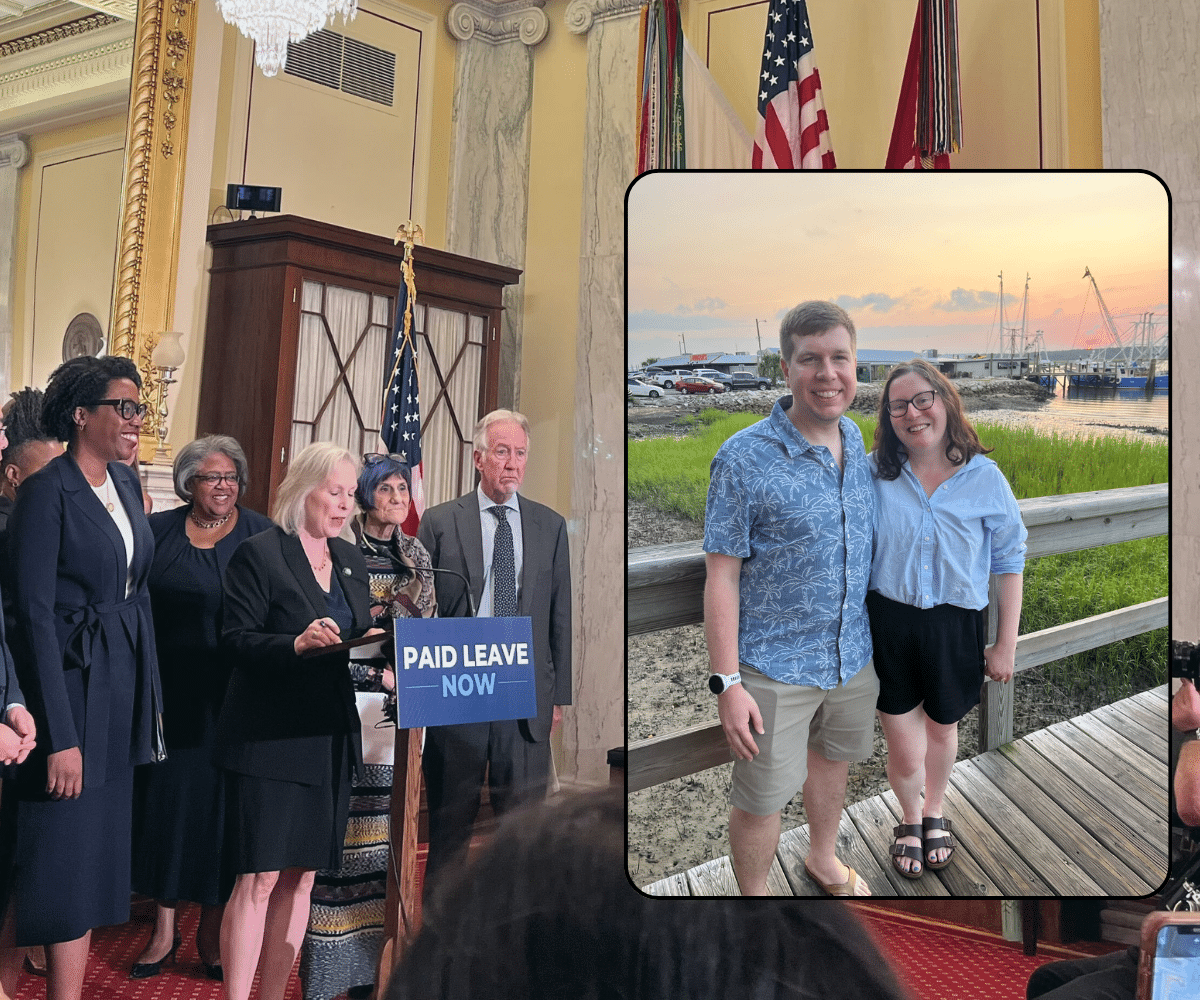
These days it can be challenging to catch our breath, to imagine more than the world we wake up to each day. As someone who lives in DC, it feels particularly heavy to navigate a world where instead of investments in families by our federal government, we have to fight to protect our city’s funding and the programs people need access to here and across the country. I show up every day at Family Values @ Work rooted in the deep belief that there is a world where our country can do more. As Federal Strategy Director, I am often monitoring threats to our communities and cuts in funding. But today, I instead get to sit in a space of vision – a space of imagining a country that recognizes care and caregiving for the essential labor that it is.
Today, Congresswoman Rosa DeLauro and Senator Kristin Gillibrand have re-introduced the Family and Medical Insurance Leave (FAMILY) Act. This legislation would establish a national paid family and medical leave program that reflects the more than twenty years of progress at the state level led by the Family Values @ Work network in fourteen states and counting. It will cover paid leave for all reasons: personal, parental, caregiving, select military related needs, and safe time for domestic violence and stalking. Additionally, to ensure a program that truly meets the needs of all families, the FAMILY Act uses an inclusive definition of family that we have championed at the state level, as well as ensures that all workers will be able to turn to work after using the benefit, and that the lowest-earners get the most of their wages back while taking leave.
This year, the reintroduction of the FAMILY Act is deeply personal. In a span of just six months, both of my husband’s parents received serious health diagnoses requiring months of treatment, surgery, and caregiving. They live in Columbia, SC, an eight-hour drive from where we live in DC. My father-in-law is a small business owner with no access to paid leave, and my mother-in-law is retired. Though my sister-in-law also resides in South Carolina, her employer provides limited vacation days and not even eight hours of sick leave.
Fortunately, my employer provides great paid leave, and my husband was relieved to qualify for DC paid family and medical leave. In January, when we anticipated my mother-in-law’s chemo starting, we made a plan on how to show up and support both of my in-laws. When my father-in-law was suddenly hospitalized and facing immediate surgery, paid leave ensured we could change our plans to meet his needs. By the next day, we were on the road to South Carolina to be available for his surgery.
When we got the call, none of us thought about filing paperwork. Our only goal was to get to our family. Despite the distance, my husband was the primary caregiver for both of his parents for a month straight- because we were the only ones in the extended family able to take job-protected paid leave. Once our family’s conditions became stable, we traveled back and forth at least monthly to help cover my mother-in-law’s chemo appointments. So far, we have each taken about six weeks of paid leave, providing huge benefits to our family while saving the cost and inconvenience of hired caregivers and drivers.
Paid leave has been a life line for our family, but it shouldn’t take living in the “right” state or having a good employer to use it. Right now, seventy three percent of private-sector workers in this country have no access to paid leave, and forty four percent of workers do not even qualify for unpaid leave under the Family and Medical Leave Act (FMLA). It does not have to be like this. We have fourteen states and counting leading the way, proving that when you take away the untenable choice between your family and your income, everyone thrives. It is time for a government that focuses on being functional and funded and that uses tax dollars responsibly to support workers and their families. A government that invests in serving our needs through programs like paid family and medical leave. Everyone will one day need to give care or receive it, and with strong policies like the FAMILY Act, we can take the vision of a care forward society, and make it a reality.


