
What Are Paid Sick and Safe Days?

Paid Sick Days (PSD) were designed for workers who needed time to care for themselves or a loved one during illness or injury. While that definition included routine doctor’s appointments and caring for chronic illness, it often did not cover some needs that occur during working hours – such as finding care in the aftermath of domestic violence and sexual assault. A new type of leave, usually referred to as Paid Sick and Safe Days (PSSD), gave workers the option of using their time to recover from violence, to seek help, to meet with their lawyers, and to find new housing. Over the 17 year history of paid sick time laws, PSSD became the norm in most jurisdictions, and safe time is finding a home in Paid Family and Medical Leave (PFML) laws as well.
At Family Value @ Work we know that good, equity-driven paid leave is ATTAIN-able. Keeping in line with our ATTAIN-able framework paid sick and safe days and paid time off policies have a chance to provide workers with shorter term paid days to take care of:
- Time to recover from physical and mental illness or injury
- Seek medical treatment or preventative care
- Care for a sick family member
- Time to address needs from domestic violence, sexual violence, or stalking
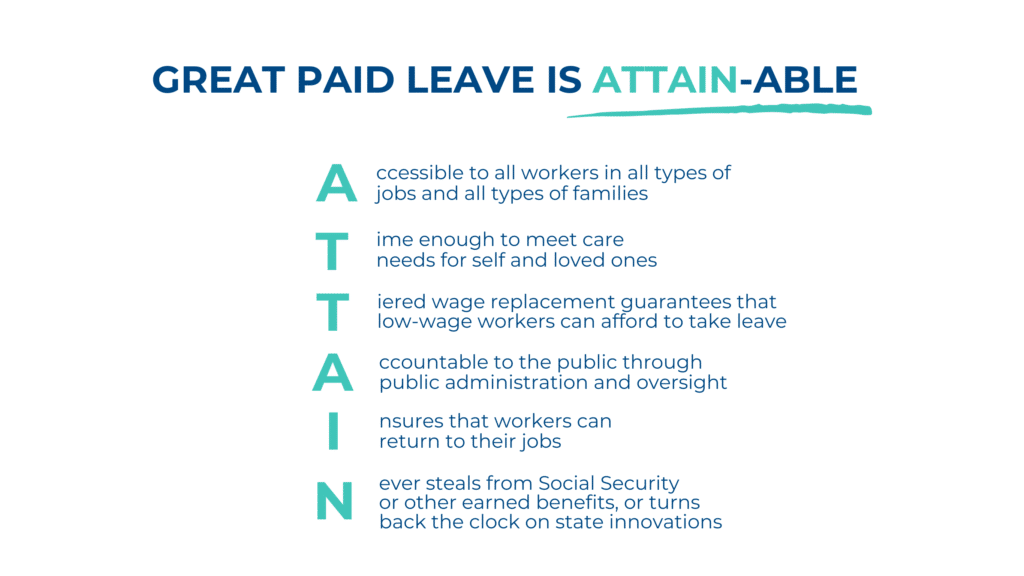
Paid sick and safe day policies must ensure that the time is paid at full wages, use an inclusive family definition, and is job protected. These short term policies are essential for our public health.
- Low-wage workers, including food service, personal health care and childcare workers, are the least likely to have paid sick days and the most helped by paid sick days laws. In 2022, only about half—53 percent—of leisure and hospitality workers had paid sick time. Similarly, only about half of food service and accommodation workers (52 percent) have paid sick time
- Paid sick days reduce the risk of on-the-job injury. In fact, according to a study by the National Institute for Occupational Health and Safety, workers who are able to earn paid sick days are 28% less likely to get injured on the job.
- Workers with paid sick days are more likely to visit the doctor once a year and get key cancer screenings such as a mammogram or colonoscopy. Workers without paid sick days are more likely to delay medical care when they are ill.
Paid leave has remarkable benefits for workers, employers, and the economy. Women are more likely to return to work, parents use less public assistance if they receive paid leave, and families are less likely to file for bankruptcy. Affordable time to care also helps the health of the person who takes the leave and their loved ones.
State and federal policy context
While current federal law sets a standard for some workers to have unpaid leave for serious illness and injury, there is no guaranteed access to time off from work for short term needs – either paid or unpaid. Despite the lack of federal protections, people working in certain jurisdictions have guaranteed paid sick and/or safe days. In November 2006, San Francisco became the first jurisdiction to pass a paid sick days law. In the past 17 years, a total of 68 cities, counties, and states (and counting) have enacted similar laws. Nearly 22 million workers earn paid time off under these laws.
Earning the time
Under paid sick days laws, employees must work a certain number of hours in order to earn one hour of paid sick time. This amount varies between 30 hours and 87 hours of work; however, most jurisdictions require between 30-40 hours of work to earn one hour of leave. In many cases, employers can choose to frontload time off at the beginning of the year instead of waiting for the employee to accrue the time off.
There is a maximum amount that can be earned. While employers may provide as much leave as they wish, each law sets a minimum amount for what they have to provide per year.
When do you get to use it?
Taking care of your health: All laws allow workers to use leave in order to receive preventative care, caring for your physical or mental health – either for yourself or a loved one. Only 3% of jurisdictions (all cities) specifically name substance abuse treatment as a reason to use leave – however, workers in other places may still be able to receive treatment as a physical or mental health issue.
Public health emergencies: 60% of all laws allow workers to use their earned sick time (i.e. get paid) if business is closed due to a public health emergency. County laws lead the way here, with 100% of county laws offering this use. 60% of laws also allow employees to care for their children using paid sick days if the child’s school or place of care closes under a public health emergency. Only in some cases is the same access given to workers who must care for elders when their places of care are shut down in the same events.
Weather events: While the effects of climate change become more drastic each year, so far, very few paid sick days laws have adapted to meet those needs. Only 6% of laws explicitly allow workers to use paid sick days during extreme weather events and natural disasters.
Achieving equity
For workers to achieve equity in paid sick and safe days laws, jurisdictions need to ensure that as many people are covered by the law as possible. All workers need access to paid sick and safe days regardless of the number of workers in a business, the number of hours they work, or even how long they’ve worked there. Workers who have committed to a new job should have the right to keep that job whether they become ill on day one or day one thousand.
Similarly, paid sick and safe days should be available to all workers to care for whomever they view as family.
The most equitable PSSD policies in effect right now:
- Cover all workers, regardless of firm size or hours worked
- Ensure all workers, including tipped workers, earn their regular pay while taking PSSD
- Eliminate tenure and work requirements to begin earning PSSD, and allow workers to begin using their time as soon as possible
- Allow workers to earn one hour of PSSD for every thirty hours worked and to accrue at least 80 hours per year
- Provide PSSD to workers when businesses, schools, and places of care close due to public emergencies and climate disasters
- Give workers the ability to care for everyone they consider family
- Prevent employers from requiring doctor’s notes until four consecutive days of absence
- Shield workers and their families during instances of domestic violence, sexual assault, stalking, and human trafficking
- Protect workers from job loss and retaliation when using their time
While some PSSD policies are more equitable than others, all have at least one place where they can improve. Advocates, administrators, and legislators can work together to continue updating and implementing PSSD laws to support their communities.


